Private customersVisitor centresMühleberg Visitor CentreModernisation of the Mühleberg hydropower plant
Hydropower
Mühleberg hydropower plant
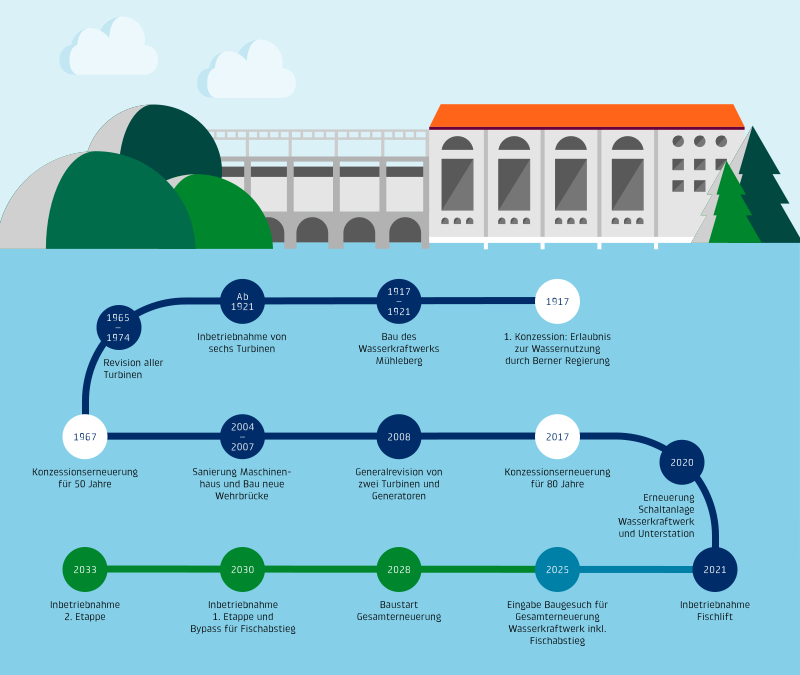
For over 100 years, BKW has been harnessing the power of the Aare at the Mühleberg site, supplying around 35,000 households in the Bern region with clean, renewable energy. The hydropower plant is now being extensively modernised. Construction work will begin in 2028, with the renewed plant gradually returning to the grid from 2030 – ensuring it remains a reliable pillar of the electricity supply in the future.
Complete refurbishment of the Mühleberg hydropower plant
BKW is investing around 120 million Swiss francs in the complete refurbishment. The aim is to increase efficiency, raise the ecological standard and secure the long-term security of supply.
The complete renewal includes the replacement of all electromechanical equipment – from turbines and generators to auxiliary systems, control and automation – as well as the refurbishment of the machine hall and building envelope in line with heritage conservation requirements.
The existing six turbines will be replaced by four modern Kaplan turbines. The intake screen cleaning system will also be modernised and operated automatically in future. The investment will increase average annual production from the current 157 gigawatt hours to around 163 gigawatt hours – enough to supply an additional 1,350 four-person households. At the same time, BKW is implementing important ecological measures: new intake screens with narrower bar spacing will prevent fish from entering the turbines, and a new bypass solution will enable them to descend into the Aare without injury. These measures are being financed by the FOEN as part of the fish passability remediation programme. A fish lift has already been ensuring safe upstream passage since 2021.To minimise outages, the renewal will take place in two construction stages: according to current planning, the first two new machines will be commissioned in 2030, and the second two in 2033. Electricity production will largely be maintained during the construction period.
Milestones of the hydropower plant
Fish descent & fish lift
As part of the complete renovation of the Mühleberg hydropower plant, the fish descent is also being refurbished. Since 2021, fish have already been able to migrate upstream thanks to the new fish lift – now their route downstream is being improved.
Plans include larger and narrower-spaced screens in front of the turbines, a more fish-friendly Kaplan turbine and a new bypass through which fish can safely leave Lake Wohlen and enter the Aare. These measures are being implemented in close cooperation with the Canton of Bern and the Federal Office for the Environment.
The fish liftIn 2021, upstream fish migration beyond the power plant was modernised. The fish have to overcome a height difference of around 20 metres. With a fish lift (see graphic), the fish are lifted around 20 metres in a tank before reaching Lake Wohlen via a channel. For downstream migration, research is still looking for suitable solutions. BKW is involved in various research projects in order to contribute its many years of experience.
Fish lift fact sheet
Download
The power plant in figures
For over 100 years, several generations have poured a great deal of passion and dedication into the Mühleberg hydroelectric power plant. Thanks to the commitment of all these people and regular maintenance and modernisation work, BKW has been able to operate the facility without interruption.
Since the plant’s output was increased in the 1970s, the power plant has produced almost 160 gigawatt hours (GWh) of clean electricity each year. This amount of electricity would be enough to supply the two cities of Bern and Thun. With the complete refurbishment, BKW is now investing in the next generation: state-of-the-art technology, greater efficiency and a higher ecological standard are making Mühleberg fit for the future.
—Existing plantOverall renewal projectCommissioning19202028 (start of construction) 2030 (commissioning of 1st stage and bypass for downstream fish migration) 2033 (commissioning of 2nd stage)1st concessionuntil 2017—2nd concessionuntil 2097—Installed capacity45 MWapprox. 36 MWAvg. annual production157 GWh, enough for approx. 35,700 4-person households (CH)approx. 163 GWh (+4%) enough for approx. 1,350 additional 4-person households (CH)WatercourseAare/Wohlensee—Machines / turbine type6x Francis, 1x Kaplan4 x KaplanHead17 - 19 m—Maximum usable water flow291 m3/s212 m3/sInvestment costs-CHF 110–130 million
Lake Wohlensee
Length12 kmMaximum width 650 mArea3.2 km2Depth18 mShoreline length29.3 kmAdjacent municipalities Wohlen, Bern, Frauenkappelen, Mühleberg, Kirchlindach
In 1952, the Schutzverband Wohlensee was founded on behalf of the five municipalities bordering the lake. The association assumes responsibility for nature, the landscape and the environment in the shore and water areas according to uniform criteria and across municipal boundaries.
History of the power plant
Who could better describe the origins of the hydroelectric power plant and the spirit of the time than Hans Markus Tschirren, the author of the book “Wohlensee”?
In it, he writes: “While Europe was bleeding dry in the First World War, and death and destruction shaped people’s thinking, something new was taking shape in the west of Bern: the Mühleberg power plant. Electricity meant the dawn of a new era. Alongside the euphoria about the new technical possibilities, it became apparent that the First World War had severely depleted stocks of coal and petroleum. The Aare and the generation of electricity as an alternative energy source therefore presented themselves as an obvious solution. If the Aare was dammed at Mühleberg with a 35-metre-high wall, a 15-kilometre-long lake would be created. From this, an infinite amount of electricity could be generated. (…) In this spirit, the Bernische Kraftwerke, under the leadership of their director, National Councillor and Colonel Eduard Will, set about the project. (…) In autumn 1920, the Mühleberg power plant began producing electricity for the first time, initially with two turbines. Four more were added the following year. The water now flooded the Aare valley, and the melancholy over the landscape disappearing beneath the water was mingled with joy at the new lake.”
Content unavailableConsent management is required for this content but is not available on this page.
More information
You might also be interested in this
  • Historic building with a tiled roof along a turquoise lake in a green hilly landscape
    Mühleberg Visitor CentreLearn more
  • Mühleberg Nuclear Power Plant
    Mühleberg Information CentreLearn more
  • Visitor centresLearn more
LinkedInYouTubeInstagramFacebookLegal noticesData protectionImprintTerms & Legal InformationPrivacy settings